
Orange County Court Records After Arrest
The arrest-to-court path in Orange County runs through the Detention Center, the Magistrate's Office, the District Attorney, and the North Carolina Judicial Branch. Booking records are maintained by OCSO. Court records are maintained by the Judicial Branch and the Orange County Clerk of Superior Court. The jail roster can show the booking charge and docket number, but the formal criminal case should be checked through the North Carolina eCourts Portal, court-date search, public terminal, or clerk's office.
Orange County is in Prosecutorial District 18 with Chatham County. The District Attorney is Jeff Nieman, and the Orange County DA phone listed in the research is (919) 644-4600. Prosecutors may amend, dismiss, reduce, add, or pursue charges after a person is booked. That is why court records after a jail arrest should not be read as the same thing as the first booking line.
The North Carolina Judicial Branch Orange County page identifies the local court district and points users to Portal, calendars, forms, and courthouse services.
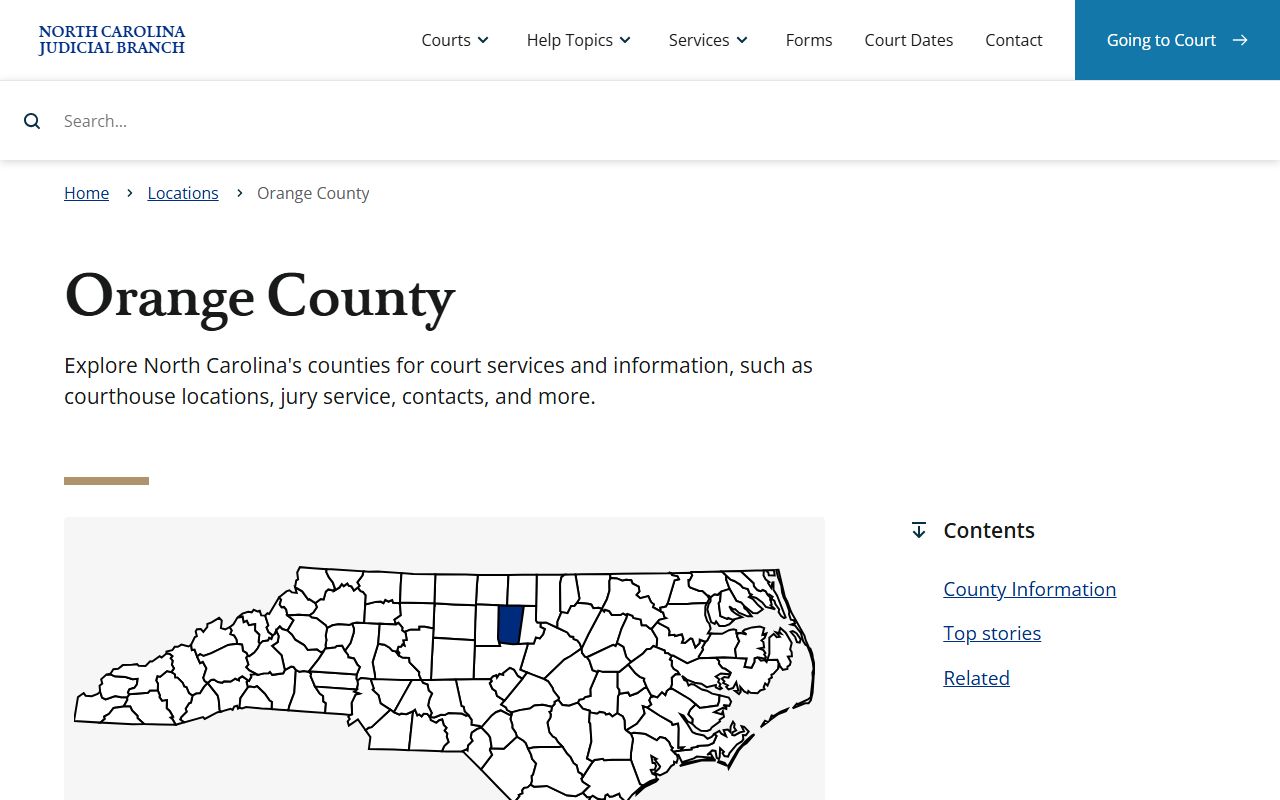
That court source is the right starting point when the question is a filed case, court date, disposition, or clerk record.
Find Orange County Court Records After Arrest
Start with the court record once the person has a docket or case number from the jail report. The OCSO Daily In Custody Report often lists 25CR or 26CR style numbers, court-date text, and location codes. Those clues can be used in the eCourts Portal, court-date search, or clerk terminal. If the jail PDF has no docket yet, the case may still be in intake, magistrate review, or early prosecutor processing.
- Use the OCSO roster to copy the name, booking number, docket, and court-date text.
- Open the North Carolina eCourts Portal or court-date search.
- Search by name, case number, citation number, Orange County, or date range where available.
- Compare the filed charge, status, and next court setting with the jail roster entry.
- Use the Orange County Clerk of Superior Court for public terminal access, paper files, or copy requests.
| Search Field | Type | Notes |
|---|---|---|
| Name | Text | Used on court-date search and public terminals. |
| Citation Number | Text | Listed by the Judicial Branch as a Portal court-date search option. |
| County | Filter | Select Orange County for local court settings. |
| Date Range | Date filter | Useful for court-date searches. |
| Case Number | Text | Use the docket from the OCSO report when available. |
| Victim or Witness Name | Terminal search | Judicial Branch says clerk terminals can search by victim or witness name. |
Charges After an Orange County Arrest
North Carolina criminal cases may begin in different ways depending on the charge and court path. The research did not locate Orange County-specific forms for every document type, so the page keeps this section practical: use the jail roster to find the booking charge and docket, then use the court record to see the filed charge and its current status. A charge can be pending before it is proved, dismissed before trial, or changed by prosecutor action.
| Document Type | Who Uses It | What It Does |
|---|---|---|
| Complaint or criminal process | Law enforcement, magistrate, or prosecutor process | Starts or supports the criminal accusation after arrest or warrant service. |
| Information | Prosecutor | States a formal charge path where allowed by law and court procedure. |
| Indictment | Grand jury and prosecutor | Formal felony charging route for cases that proceed in superior court. |
Orange County Charge Status
The jail roster may show status codes such as PRET, SENT, HOLD, DSMD, and TSVD, while the court case may show pending, dismissed, disposed, convicted, amended, or reduced. Do not treat a bond amount, arrest charge, or first roster entry as proof of guilt. The court record is the better source for current charge status and final disposition.
| Status | What It Means |
|---|---|
| Pending | The case is active and no final disposition is shown. |
| Amended or reduced | The filed charge changed from an earlier booking or case entry. |
| Dismissed | The court record shows the charge did not continue to conviction. |
| Disposed | The case has reached an outcome, such as plea, finding, dismissal, or other resolution. |
| Convicted | A guilty plea, verdict, or finding created a conviction record. |
Bond After an Orange County Arrest
OCSO says the Magistrate's Office is inside the Detention Center, so bond processing is closely tied to the jail after arrest. The roster can show bond dollar amounts and codes such as SECU for secured bond, UNSE for unsecured bond, NOBD for no bond, INCL for included bond, and SERV for service or sentenced status. A person may have different bond treatment by charge, and one hold can block release even when another charge appears bondable.
| Bond or Hold Type | How It Works |
|---|---|
| Secured bond | Release generally requires cash, property, or a surety/bondsman arrangement. |
| Unsecured bond | No upfront secured payment is required, but the person remains bound to appear. |
| No bond | The listed charge or hold currently has no bond available. |
| Included bond | The charge line appears included with another bond decision. |
| Hold or detainer | Another agency, case, writ, or legal matter may prevent release. |
Warrants and Orange County Arrest Records
No official Orange County Sheriff's Office active-warrant search page was located in the official-source sweep. The practical official fallback is the court record and court-date search when a missed court date, order for arrest, bench warrant, or failure-to-appear issue may exist. The OCSO current detainee PDF can show warrant-related custody after the warrant has produced a booking, including order-for-arrest and failure-to-appear charge text.
Do not rely on commercial warrant sites. For custody, call OCSO or the Detention Center. For court process, use the eCourts Portal, court-date search, the clerk's office, or the magistrate number listed by the Judicial Branch contact directory. For case-specific risk, a licensed attorney is the right route.
Charges vs Convictions
An Orange County arrest or booking charge is an accusation and custody reason. It is not a conviction. The court record may later show dismissal, reduction, plea, trial result, or other disposition. This distinction matters for readers using jail data, because a current detainee report is a custody snapshot and not a final criminal-history report.
| Charge | Conviction | |
|---|---|---|
| Stage | Accusation or filed count | Final guilty plea, verdict, or finding |
| Where It Appears | Jail roster and court case | Court disposition and criminal-history records |
| Meaning | Not proof of guilt | Formal outcome unless later expunged or changed |
Expunged Orange County Arrest Records
North Carolina uses expunction language for records that are cleared after eligible outcomes. G.S. 15A-146 may allow expunction by petition after dismissal or a not-guilty finding in the county where the charge was brought. G.S. 15A-153 describes the effect as clearing public record entries of arrest, charge, or conviction. Expunction is a court process, not an OCSO website removal button.
| Sealed or Restricted | Expunged | |
|---|---|---|
| Visibility | Hidden or limited from ordinary public access | Cleared from public record entries as the order directs |
| Process | Depends on court rule or statute | Requires eligible petition or statutory process |
| Orange County Route | Check clerk or court order | Use the Judicial Branch expunction process and statutes |
Restricted Court Records After Arrest
North Carolina Chapter 132 is the public-records backbone, but it has limits. Criminal investigation and intelligence records may be treated differently from basic public records. Juvenile photographs and juvenile records are restricted. Medical, security, and some jail-operation materials can also be limited. The Judicial Branch court-records instructions explain public terminals, Portal information, paper files, and copy requests.
Important: A public court record can be incomplete online. Use the clerk's office for official file access and copies.